
Breeding programs on today’s most progressive dairies don’t stop at a sexed and beef semen strategy. Farms planning for the long-term success of their herd are also implementing embryos as part of their genetic strategy.
Embryos in a breeding program can look different across operations, so let's break down why to consider using embryos, what your embryo options are, where embryos are most successful and how to go about making the switch from semen alone to an embryo-inclusive program.
Why consider embryos?
In recent years, dairy herd reproductive success has improved, which has given many farms the advantage of more options and a more strategic approach to their breeding programs.
Embryos take the benefits of today’s sexed and beef strategy one big step further. With proper data and an intentional, well-executed strategy in place, embryos are a way to ramp up progress toward long-term success even faster.
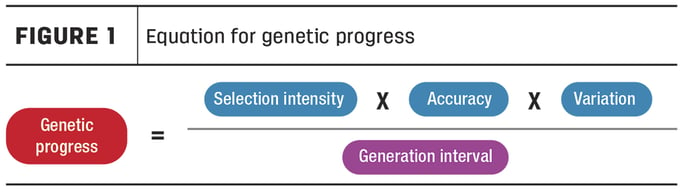
This success hinges on the equation (Figure 1) for genetic progress.
Farms using embryos fast-track their progress for long-term genetic success for a few reasons:
- Selection intensity: Using only the most elite females as mothers of the next generation takes selection intensity to a whole new level. Now, instead of driving selection intensity only through sire selection, you’ll be driving more intense selection on the female side as well. This part of the genetic progress equation is most impacted by using embryos rather than semen.
- Generation interval: The most elite genetics in a herd are often the youngest. That means the fastest genetic progress generally comes from choosing younger animals as dams of the next generation, which means a shorter interval from one generation to the next as compared to using only sexed or conventional semen.
- Accuracy: Many farms implementing an embryo program are tuned in to the importance of their herd’s data, and they make use of genomic testing as part of their strategy. While genomic testing and embryo programs are not mutually exclusive, the increased adoption of genomic testing as part of a bigger picture embryo program means a steep uptick in the accuracy of the plan.
- Variation: This part of the equation refers to the genetic variation of the breed and is generally least impacted on a herd-level basis.
Who should consider embryos in their farm's breeding program?
Embryos certainly fast-track progress in a farm’s breeding program. But this approach is not for everyone. If you are wondering whether embryos are a fit for your dairy, here are some baseline requirements and some additional reasons why progressive dairies have chosen to fast-track their genetic progress and are successful with the approach.
- You already have strong reproductive performance.
- Your team is engaged in the success of the farm and open to trying new processes and new technology.
- Communication between your decision-makers, managers and employees is regular, open and transparent.
- You prefer to make decisions based on data.
- You have goals in place that you want to achieve in the short term and long term.
- You are already using the best possible bulls that fit your genetic goals.
- A genetic audit showed a large gap between your best genetics and worst genetics.
- You know you want to leave your farm and your herd at the best possible level for your next generation.
- You were already genomic testing and want to use this data to speed up genetic progress even faster.
- You operate in a region where summers are extremely hot, and you are looking for a way to keep genetic progress moving forward, even when pregnancy rates to sexed semen went on a sharp decline.
- You just completed an expansion, and since your cows have an ideal environment where genetics can shine, you want to make the most of it.
- You want to change breeds.
What are your options with embryos?
Purchased embryos
This option suits many different scenarios. Maybe you are a farm looking to jump a generation on your genetic progress. Maybe you purchased semen on a limited budget in the past and want to catch up to the genetic level of your peer group. Or maybe you want to try IVF embryos but aren’t quite ready to start the whole process of making them from your own females.
Regardless, embryos purchased from elite breeding programs can get you started to ramp up the intensity of how you select the dams of your next generation right off the bat. And since these embryos can be created with sexed semen, that means you can still create more females from the best possible genetics.
IVF embryos created in your own herd
This embryo option is best suited if you have invested in genetics over the years and have used the best bulls for many generations. Creating and implanting IVF embryos from donors in your own herd is a next step to help you focus in on the benefits of more intense selection of your own females.
Terminal beef embryos
In today’s market, we know that beef-on-dairy is a lucrative income generator for many dairies. Depending on your market and your calf buyer, terminal beef-on-beef embryos are a third option for dairies to consider for capturing additional revenue where pure beef calves are in demand.
This is especially true if you are running a Jersey herd, where your resulting beef-on-dairy calves do not garner the premium that Holstein herds currently earn. Or if you are currently raising your own beef-on-dairy calves, then terminal beef embryos are an option you should consider to further boost your beef quality and efficiency.
Practical examples
Let’s look at genetic examples of two very different herds. Herd 1 recently expanded and purchased many animals to fill their new facilities, including animals with unknown pedigrees. Figure 2 shows the number of animals that they have at each level for parent average NM$.
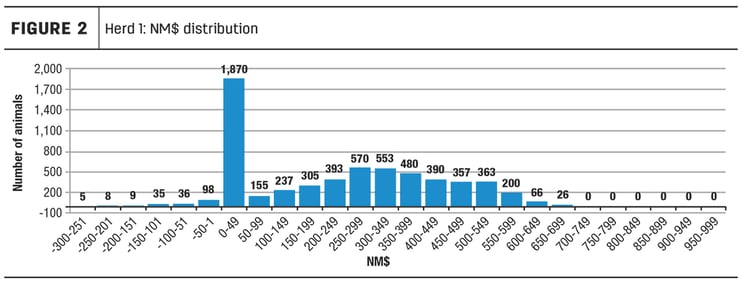
This herd is an example where purchased embryos could be a great fit because of the large amount of unknown genetics. If their repro performance is steady and their team is committed, then using purchased embryos that they implant in the unknown or lower genetic animals will help them improve the ID accuracy within their herd and make more genetic progress than if they used only sexed/conventional semen.
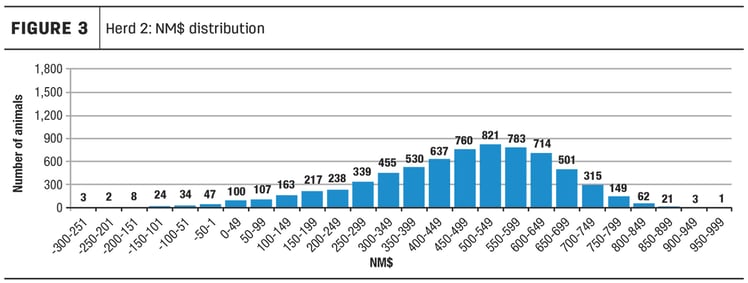
Herd 2 is a mature herd looking to maximize the performance and profitability of their farm, rather than expand in numbers (Figure 3). They have used top-end bulls for many years, and they have recently started genomic testing. Because their focus has been on high genetic merit for many years, they have access to high genetic females that could very effectively serve as IVF dams for an in-herd embryo program. In this case, we would choose from among the top females for NM$ or their own genetic index, create embryos from those females and semen from the best sires in the industry, and then implant the embryos in the lower genetic females.
And because the approach to which type of embryos to use can be mixed, if this herd is looking to jump even further, they could also purchase embryos from elite donors outside of their herd to amplify their genetic progress even further.
How do you get started with embryos?
If you are looking to fast-track progress for long-term success in your herd, or even learn how this could look on your farm, work with your trusted genetic adviser and herd veterinarian to explore the right options for you. When your strategy puts pressure on increased selection intensity, more accuracy and a shorter generation interval, that is when you know you are making the most of your breeding program, and embryos can very likely be part of that.